Solid-phase microextraction (SPME)

Mobirise Website Builder

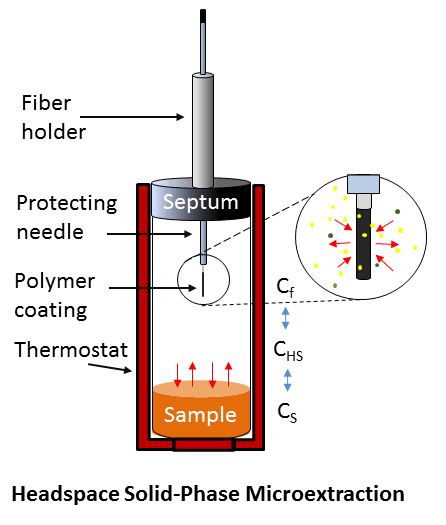
The method of solid-phase microextraction (SPME) through the vapor phase (VP) above the sample is considered one of the most promising among existing sample preparation methods for determining organic pollutants in environmental samples, as it is simple, does not require the use of solvents, can be automated, and allows achieving low detection limits at a very low cost of analysis. The VP SPME method is based on the extraction of analytes from the gas phase above a liquid or solid sample using a microcoating. Unlike SPME with immersion of the coating directly into the sample, VP SPME provides a longer fiber lifespan, minimal instrument maintenance, and analysis cost.

Sample preparation using SPME:

  1. Place the sample in the vial and seal it tightly using an appropriate gasket
  2. Heat the vial to the desired extraction temperature and wait for equilibration
  3. Insert the fiber holder into the vial and position it in the gas phase above the sample (for volatile analytes) or directly in the sample (for non-volatile analytes)
  4. Expose the fiber and hold for the desired extraction time
  5. Hide the fiber in the protective needle and remove the holder from the vial
  6. Insert the fiber holder into the heated injector port of the gas chromatograph.
  7. Expose the fiber and hold for the desired desorption time
  8. Remove the fiber from the gas chromatograph injector

Shape your future web project with the Mobirise app.

  • Practical
  • Quick
  • Inexpensive (one fiber > 500 analyses, only a vial and a gasket are needed for analysis)
  • Does not require toxic solvents
  • Only volatile compounds are extracted from the gas phase, which simplifies the maintenance of the GC sample introduction device.
  • Easily automated using autosamplers CTC Combi-PAL, Gerstel MPS, Thermo Tri-Plus or HTA HT280T
  • "Green" method (has very little impact on the environment)

Application of SPME:

  • Environmental object analysis (air, water, soil)
  • Food Quality Control
  • Medicine
  • Forensic examination
  • Any scientific research

Detection limits:

  • Depends on the affinity of the extraction coating to the analyte and the matrix effect
  • For very hydrophobic analytes (log Kow > 4): 1 ppt
  • For polar compounds (log Kow < 0): 1 ppb

Optimizable parameters:

  • Ratio of sample volume to gas phase above it
  • Composition and size of the extraction coating
  • Extraction temperature
  • Extraction time
  • Amount of salt and other substances added
  • pH
  • Desorption temperature
  • Desorption time

Application of the solid-phase microextraction method in the laboratory:

  • Screening and quantitative determination of rocket fuel transformation products (unsymmetrical dimethylhydrazine) in water and soil
  • Screening and quantitative determination of volatile organic compounds in ambient air, water, and soil
  • Screening of volatile organic compounds in alcoholic beverages (wine, cognac, vodka, whiskey, etc.)

Course of interactive lectures on solid-phase microextraction

If you want to master the solid-phase microextraction method, take the course of interactive lectures currently being developed by the laboratory staff.

The course includes the following interactive lectures:

  1. Introduction to solid-phase microextraction (in Russian and English)
  2. Quantitative analysis using solid-phase microextraction (in Russian and English)
  3. Development and optimization of analytical methods based on solid-phase microextraction (in development)
  4. Air analysis using solid-phase microextraction (in development)
  5. Soil analysis using solid-phase microextraction (in development)
  6. Water analysis using solid-phase microextraction (in development)
  7. Solid-phase microextraction under vacuum (in development)

Training in the theoretical foundations of the method using computer modeling

To better and faster understand the basics of the solid-phase microextraction method, we recommend using computer modeling in COMSOL Multiphysics. The modeling results can be visualized to see how the analyte concentration changes at various points in the sample container and extraction fiber. It is also possible to understand how different parameters affect the extraction process.
Video of the process of taking a time-weighted average sample of VOCs using solid-phase microextraction in COMSOL Multiphysics.
The video of the analyte extraction process from a water sample is available in the appendix to the following article:
Kenessov B., Derbissalin M., Koziel J.A., Kosyakov D.S., 2019. Modeling solid-phase microextraction of volatile organic compounds by porous coatings using finite element analysis. Analytica Chimica Acta 1076, 73-81.

Drag & Drop Website Builder