Identification of new potentially hazardous volatile and semi-volatile organic pollutants in Almaty and its suburbs using solid-phase microextraction

Project of the Science Committee of the Ministry of Science and Higher Education of the Republic of Kazakhstan AP23484339

Mobirise Website Builder


Relevance of the project:

Almaty is the largest metropolis in Kazakhstan, with a rapidly growing population and economy. However, its sustainable development is complicated by a high level of morbidity among the population, a significant part of which may be caused by environmental pollution. Despite the high toxicity of many volatile and semi-volatile organic compounds (VOCs and SVOCs), there is very little information about their presence and concentrations in environmental objects in the city of Almaty and its suburbs, which is apparently due to the high complexity and cost of analysis using classical sampling and sample preparation methods. Solid-phase microextraction (SPME) is a simple and cost-effective method of sampling and sample preparation that is successfully used for environmental research in Kazakhstan.

Project goal:

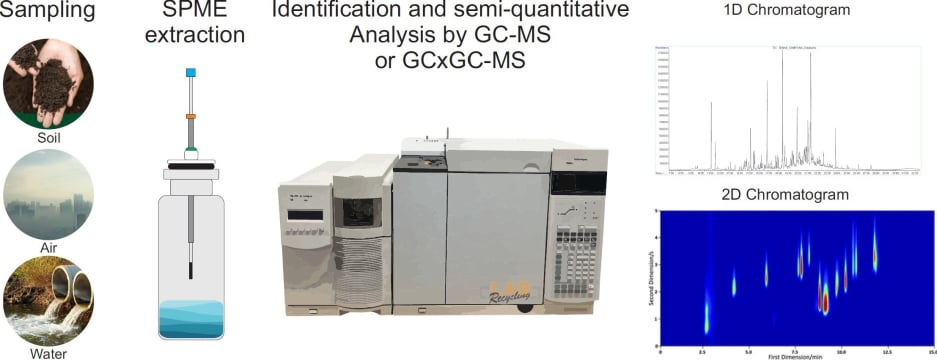
The project is aimed at identifying new potentially hazardous volatile and semi-volatile organic compounds in environmental samples collected in the city of Almaty and its suburbs, using SPME combined with one- and two-dimensional gas chromatography with mass spectrometric detection (GC-MS and GCxGC-MS)

Project objectives

  1. Development of methods for simultaneous identification and semi-quantitative determination of volatile and semi-volatile organic compounds in environmental samples using solid-phase microextraction combined with one- and two-dimensional gas chromatography with mass spectrometric detection.
  2. Sampling of environmental samples in the city of Almaty and its suburbs.
  3. Analysis of environmental samples collected in the city of Almaty and its suburbs using developed methods for the identification of volatile and semi-volatile organic compounds and determination of their approximate concentrations.
  4. Identification of the most hazardous volatile and semi-volatile organic compounds detected in collected environmental samples.
  5. Development of recommendations for improving the environmental safety system in the city of Almaty and its suburbs and their dissemination among potential end users.

Project participants:​

  • Kenessov Bulat Nurlanovich - project leader, Ph.D. in Chemistry, professor, chief research scientist, ResearcherID: C-7013-2012, ORCID: 0000-0001-8541-0903, Scopus Author ID: 23479696100
  • Bukenov Bauyrzhan Omirbekovich - research associate, PhD, ResearcherID: AAV-5565-2020, ORCID: 0000-0002-3582-6887, Scopus Author ID: 57216649008
  • Bakaikina Nadezhda Viktorovna - research associate, PhD, ResearcherID: GRX-8517-2022, ORCID: 0000-0002-5771-9417, Scopus Author ID: 56688538900
  • Kurmanbayeva Tolkyn - junior researcher, doctoral student, ResearcherID: KSO-0687-2024, ORCID: 0000-0001-7109-1200, Scopus Author ID: 57220036264
  • Karimkyzy Nurbi - engineer, ResearcherID: KTD-1159-2024, ORCID: 0009-0008-0216-0098, Scopus Author ID: 59145555500
  • Ermakhan Madina - engineer, ORCID: 0009-0007-6605-2048
  • Smayl Aruzhan - laboratory assistant, ResearcherID: KSX-1419-2024, ORCID: 0009-0009-4294-1611, Scopus Author ID: 59145645600
  • Dyusenkulova Balgin - laboratory assistant
  • Ilyas Amirali - laboratory assistant, 2nd-year student of the Faculty of Chemistry and Chemical Technology

Used methods:

  • Gas chromatography with mass spectrometric detection
  • Two-dimensional gas chromatography with mass spectrometric detection
  • Solid-phase microextraction

Expected results:

  • two articles in journals from Q1-Q2 (Web of Science)
  • three methods for simultaneous identification and semi-quantitative determination of volatile and semi-volatile organic compounds in air, water, soil, and sediments based on SPME-GC-MS and SPME-GCxGC-MS
  • list of new VOCs and SVOCs detected in environmental samples from the city of Almaty and its suburbs, ranked by toxicity, concentration, and frequency of detection
  • recommendations for improving the environmental safety system in the city of Almaty and its suburbs

The obtained results will be disseminated through the laboratory's website (ecobio.cfhma.kz), social networks (ResearchGate, Facebook), and the media (if journalists are interested after we contact them). During the project, at least three conference presentations are planned - one at Pacifichem-2025, one at the International Symposium on Advances in Extraction Technologies Conference - 2026, and one at the European Annual Meeting SETAC 2026. Letters describing the developed methodologies, obtained results, and recommendations for improving the environmental safety system of Almaty and its suburbs will be sent to the akimats of Almaty and Almaty region, the Ministry of Ecology and Natural Resources of Kazakhstan, Kazhydromet, and laboratories conducting environmental analyses.
The methodologies for simultaneous identification and semi-quantitative determination of VOCs and SVOCs in environmental samples based on SPME will be ready for use in laboratories conducting environmental research, monitoring, and forensic environmental expertise. They will allow for faster, cheaper, and more accurate environmental studies for the identification and quantitative determination of VOCs and SVOCs. It will be possible to analyze a larger number of samples, which is very important for such a large country as Kazakhstan.
The list of new VOCs and SVOCs detected in environmental samples of Almaty and its suburbs, ranked by toxicity, concentration, and frequency of detection, can be used by environmental scientists to plan more detailed studies on the impact of these pollutants on the environment and human health, identify sources of pollution, and reduce them. The methodology used in this project can be applied to identify potentially hazardous VOCs and SVOCs in other cities of Kazakhstan and other countries.
The developed recommendations for improving the environmental safety system in Almaty and its suburbs can be used to enhance environmental regulation in Almaty and Kazakhstan to improve environmental quality and ensure their sustainable development (UN Sustainable Development Goals 3, 6, and 11). As a result of implementing these recommendations, concentrations of detected VOCs and SVOCs posing a high risk to the environment and human health will be reduced. In the long term, the project's results may reduce the cost of environmental monitoring and make the environment cleaner and safer.
During the project, one Doctor of Philosophy (Tolkun Kurmanbayeva) and two Masters (Nurbi Karimkyzy and Zhansaya Rymzhanova) will be trained. After the project's approval for funding, it is planned to involve another doctoral student in the project.
Main results obtained (as of January 2025)

1. A gas chromatograph with a mass spectrometric detector Agilent 7890B/5975C was received and installed, equipped with a split/splitless inlet, interface (transfer line), diffusion pump, electron impact ionization source, foreline pump, HP-5MS column, computer, and software.
2. Methods for the identification of volatile and semi-volatile organic compounds in air, water, soil, and sediment samples using solid-phase microextraction combined with one-dimensional gas chromatography with mass spectrometric detection have been developed.
3. Methods for determining approximate extraction efficiency values of volatile and semi-volatile organic compounds from environmental samples using solid-phase microextraction have been developed.
4. The manuscript of the article "Semi-quantitative determination of volatile and semi-volatile organic compounds detected in air using solid-phase microextraction and gas chromatography-mass spectrometry" was submitted to the Journal of Separation Science (IF = 2.8, second quartile in the "Chemistry, Analytical" category). A "Major Revision" decision was received with comments from 4 reviewers.
5. An oral presentation on the topic "Simultaneous cost-efficient identification and semi-quantitative determination of volatile and semi-volatile organic compounds in air, water and soil using solid-phase microextraction" was presented at the Pacifichem-2025 symposium (USA).
6. In the city of Almaty and its suburbs, 301 environmental samples were collected, including 115 soil samples, 40 sediment samples, 92 water samples, and 54 air samples.
7. Using the developed methods, chromatograms of 207 environmental samples collected in the city of Almaty and its suburbs were obtained.
8. Preliminary project results were announced by the project leader at a meeting of the Deputy Akim of Almaty city Nukenov A.N. with young scientists.

Publications within the project

1. Haddadi S., Koziel J.A., Kenessov B. Green sampling of gas-phase volatile organic compounds using time-weighted average solid phase microextraction and gas chromatography-mass spectrometry: A critical review. - Green Analytical Chemistry. - 2025. - Vol. 15. - Article 100302. (If = 6.2, Q1 in Chemistry, Analytical)

Conference Presentations

1. Kenessov B., Bakaikina N., Bukenov B., Karimkyzy N., Yermakhan M., Dyussenkulova B., Kurmanbayeva T. Simultaneous cost-efficient identification and semi-quantitative determination of volatile and semi-volatile organic compounds in air, water and soil using solid-phase microextraction // Pacifichem - 2025, USA, oral presentation

To potential users of developments:

If you are interested in using the developed model, please contact the project leader Bulat Nurlanovich Kenessov at bkenesov@cfhma.kz. We are continuously looking for companies ready to commercialize and implement the laboratory's developments.

AI Website Generator